Most prospective clients don’t call out of the blue. They browse your site. They skim your content. And sometimes, they download a guide.
That guide, if done well, can start a meaningful relationship.
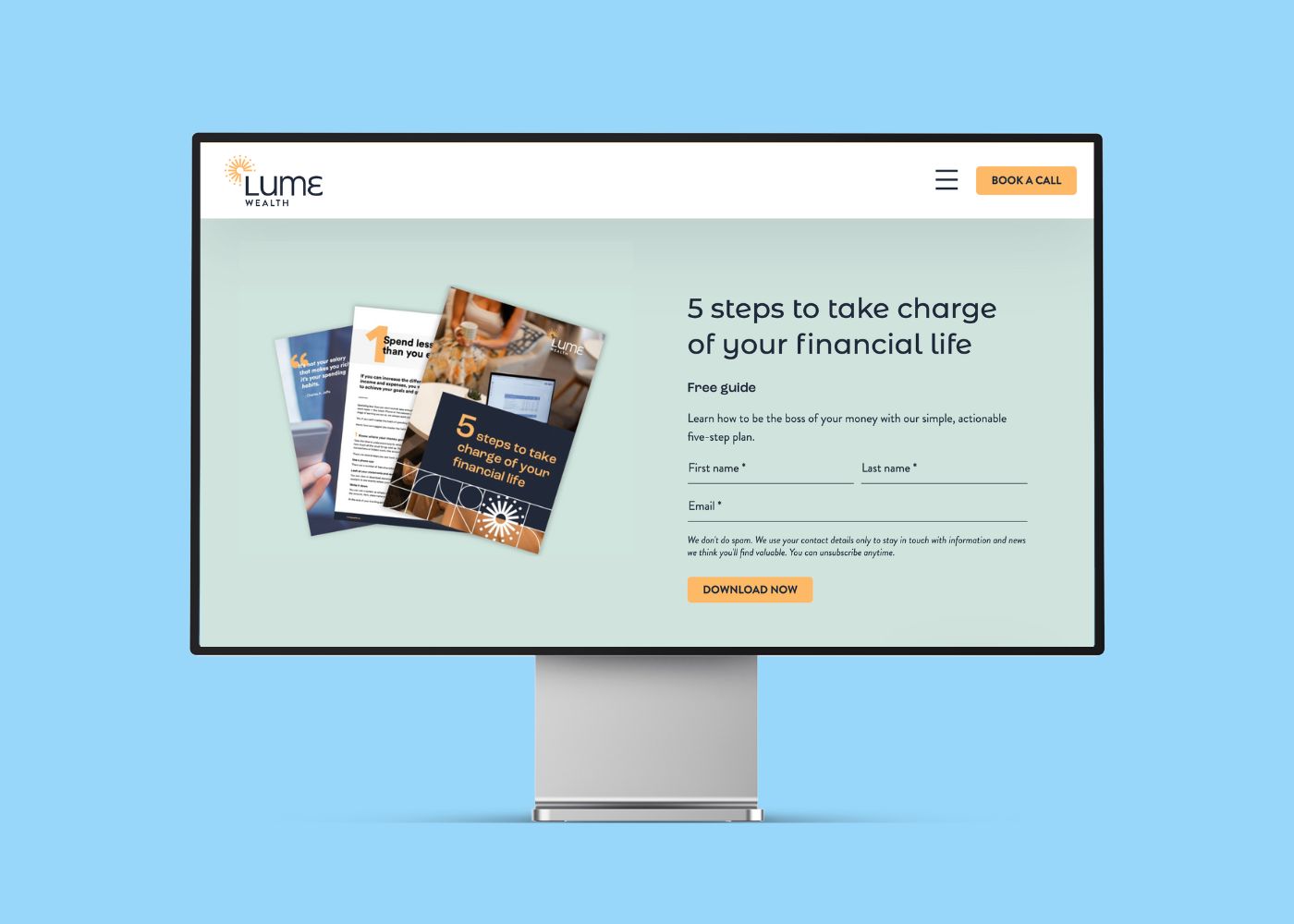
An ebook doesn’t need to be long or flashy. It just needs to answer a real question your ideal client is asking. When offered in the right place, it can educate, demonstrate value, and give people a reason to stay connected.
Why ebooks work for financial advisers
In an industry built on trust, an ebook does more than just capture a name and email.
It shows you understand your audience. It gives your prospective client something useful. And it starts the relationship with value – not a sales pitch.
A strong ebook can:
- Build credibility without needing to ‘sell’
- Help a reader self-identify with your niche
- Provide a reason to stay in touch (especially when paired with a nurture email campaign)
- Segment your leads by interest or service area
What makes a good ebook?
The best ebooks are helpful, relevant, and easy to read.
That means:
- One clear topic – not a broad overview
- A clearly defined audience – e.g. “entreprenurial business owners planning exit” (not “retirees in their 60s”)
- Concise structure – ideally 4–6 pages of practical content
- Authentic tone – like your client conversations, not corporate speak
You don’t need to answer everything. The goal is to offer clarity, spark interest, and leave them wanting more.
Ebook topic ideas for advice firms
Struggling to think of what to write? Here are some niche topic ideas that resonate.
- “What to expect from your first financial advice meeting”
- “5 mistakes to avoid when retiring early”
- “How we help business owners build personal wealth”
- “Superannuation tips for Australian start-up entrepreneurs”
Each one is tied to a real curiosity or concern. The goal is to help, not impress. And ideally, the reader should feel like you understand their situation better than they can explain it themselves.
Where to use your ebook
Ebooks can live in multiple places across your website and marketing:
- Homepage – especially effective with a strong call-to-action
- Service or niche pages – align ebook topic with page focus
- Resources section – build a library of helpful downloads
- Follow-up emails – great as a thank-you or warm-up
- Social media or paid campaigns – offer value upfront
Wherever you place it, make sure the context makes sense (i.e., a retirement-focused ebook belongs on your retirement services page).
ebook esign and delivery tips
You don’t necessarily need a graphic designer to build a great ebook. Tools like Canva or Adobe Express make it easy to format professional PDFs with minimal effort.
Keep it clean:
- Use large headings and short paragraphs.
- Include your logo, contact info and a call to action at the end.
- Add visual interest like on-brand icons, photos, and charts.
- Consider that every ebook should include a clear call to action, such as booking a call.
For delivery, use an email platform (like Mailchimp or Active Campaign) to automatically send the ebook when someone completes your form.
Make it part of a bigger journey
The ebook is just the start. Pair it with a series of nurture emails to keep the conversation going.
Here’s a simple flow:
- Visitor downloads your ebook
- They receive the PDF via email
- Over the next few weeks, automatically share a few short emails that educate, explain your process, or invite a conversation
You’ve now gone from “cold visitor” to “warm, informed lead” without a single phone call.
Want to add an ebook to your site?
You don’t need to start big. Even a 4-page mini guide can deliver value and get results.
Many of our clients repurpose content they already have – from blogs, presentations, or FAQs – into ebooks that attract, educate and convert.
If you’d like help structuring or designing one, we’re always here to support. But whether you DIY it or not, having an ebook is a smart way to show expertise before the first meeting.
Ebooks FAQs
Yes, both apply. Under the Spam Act 2003 (Cth), you can only send commercial electronic messages to people who have given express or inferred consent. When someone downloads your ebook and provides their email address in exchange, that constitutes express consent, provided your form makes clear they will receive follow-up emails from you. A simple line near the submit button, such as “By downloading, you agree to receive occasional emails from [Firm Name]”, is sufficient. Unchecked opt-in checkboxes are safer than pre-checked ones.
Under the Privacy Act 1988 (Cth) and the Australian Privacy Principles, you are also required to handle that personal information securely, use it only for the purpose it was collected, and make your privacy policy accessible. Your privacy policy should be linked to the download form. The Australian Communications and Media Authority (ACMA) publishes guidance on the Spam Act at acma.gov.au, and the Office of the Australian Information Commissioner (OAIC) covers privacy obligations at oaic.gov.au. This article does not constitute legal or compliance advice, and you should seek your own guidance specific to your firm’s circumstances.
In most cases, yes. An ebook that discusses financial topics, even in a general educational context, is likely to be considered a financial services document or promotional material under your Australian Financial Services (AFS) licence obligations. Most licensees require that marketing and educational materials be reviewed and approved before publication. The key question is whether the content could be construed as advice or a recommendation, even implicitly.
For example, an ebook titled “5 mistakes to avoid when retiring early” that discusses specific strategies may require closer scrutiny than one titled “What to expect from your first financial advice meeting.” Before publishing, submit the draft to your licensee’s compliance team and confirm whether a general advice warning is required. If you are not sure who to contact, start with your compliance manager or refer to your licensee’s marketing and communications policy. Getting this step wrong can expose your firm to regulatory risk under the Corporations Act 2001 (Cth).
A nurture email campaign is a pre-written sequence of emails that is automatically sent to someone after they complete a specific action, in this case, downloading your eBook. The goal is to gradually build familiarity and trust over weeks, moving the recipient from a curious stranger to a warm prospect. A simple sequence for an advice firm might look like this: email one delivers the eBook immediately, email two a few days later shares a short insight related to the eBook topic, email three a week later explains how your firm helps clients in that situation, and email four invites them to book a conversation.
Platforms like Kit, Mailchimp, and ActiveCampaign both offer drag-and-drop automation builders that do not require any coding knowledge. You write the emails, set the timing between each one, and the platform handles delivery automatically. Most platforms offer free tiers suitable for smaller firms starting out. The article’s suggested flow of download, delivery, and a few follow-up emails is a practical starting point that you can expand as your confidence grows.
Gating requires a visitor to submit their name and email before they can access the ebook. It is a common and legitimate approach, but it does create a small barrier. The key to reducing drop-off is making the value of what they are receiving obvious before they reach the form. A compelling headline, a brief description of what the eBook covers, and one or two lines about who it is for will do more to convert hesitant visitors than any design change.
If your ebook addresses a very specific situation, such as superannuation strategies for business owners approaching exit, the specificity itself reassures the right reader that it is worth their time. For visitors who are not yet ready, consider including a visible link to a related blog article or your services page nearby, so they have somewhere useful to go rather than simply leaving. Some firms also offer a short preview of the first page to reduce perceived risk before submitting the form.
There are three numbers worth tracking from the start. The first is the conversion rate on your download page, which is the percentage of visitors who land on the page and complete the form. A rate above 20 to 30 per cent suggests your offer and page copy are well-aligned with what visitors want. If it is significantly lower, the disconnect is usually in the headline or the description rather than the eBook itself.
The second number is the email open rate across your nurture sequence, which indicates whether the follow-up content is resonating. The third, and most important, is the number of enquiries or booked calls attributable to leads who came through the eBook funnel. Most email platforms, including Mailchimp and Active Campaign, show open and click rates per email. To track enquiries back to the eBook, ask new contacts in your intake form how they heard about you, or set up a tagged link in your final nurture email that points to your booking page so you can see click-throughs in your platform’s reporting dashboard.

The Trust Stack
Subcribe for exclusive adviser insights to build credibility at scale.