Local SEO is essential for financial advisers, accountants, and mortgage brokers looking to attract clients in their area. A well-optimised website ensures your business appears in local searches, helping you connect with prospective clients actively seeking your services.
This guide outlines a chronological approach to strengthening local SEO, from setting up your Google Business Profile to refining your website for local search dominance.
Many of the following steps can be managed in-house, but others would benefit from professional support, just as your clients benefit from your financial advice!
For assistance with anything covered in the article, please contact us.
1. Optimise your Google Business Profile
A Google Business Profile is the foundation of local SEO, ensuring your business appears in Google Search and Google Maps when prospective clients look for financial advice services nearby.
Key steps to set up your Google Business Profile properly
- Select the right business categories that reflect your services.
- Write a compelling business description using location-based keywords (e.g., “Financial adviser in Byron Bay”).
- Upload high-quality images of your office, team, and logo.
- Regularly post updates, articles, or promotions to engage prospective clients.
- Ensure your services, contact information, and all other details are accurate.
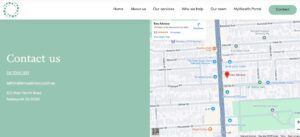
- Clients need to find your business easily, and Google prioritises locations with structured data and optimised local intent. Integrating Google Maps will boost your SEO and client experience.
2. Boost credibility with local citations and backlinks
Local citations and high-quality backlinks improve credibility and help your website rank higher in local search results.
How to get citations
- List your business in local directories like Adviser Ratings, Yellow Pages, and TrueLocal.
- Ensure your contact information is consistent across all directories and listings, including your website, social media platforms, and business cards, etc.
- Use industry-specific directories such as the FAAA directory for financial advisers.
How to get local backlinks
- Get featured on local news sites, finance blogs, and business directories.
- Partner with local businesses for cross-promotion and shared content.
- Speak at community events or business meetups and get mentioned online.
3. Build trust, SEO, and authority with reviews
Google Reviews play a significant role in building trust and boosting search rankings.
Best practices to manage Google Reviews
- Ask satisfied clients to leave Google Reviews about their experience.
- When requesting Google Reviews, be mindful of ASIC regulations. Ensure testimonials do not imply guaranteed outcomes and align with FAAA compliance guidelines.
- Respond to all reviews as soon as possible. Thank positive reviewers and address concerns professionally.
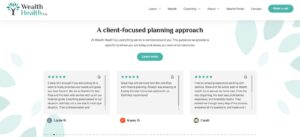
- Showcase client testimonials prominently on your website.
- Learn more about our best practice tips for collecting and managing Google Reviews in our blog here.
Demonstrate expertise online
Google prioritises content that demonstrates Experience, Expertise, Authoritativeness, and Trustworthiness, critical factors in financial services. Strengthen your credibility by employing the following.
- Showcase your qualifications: Add an About page highlighting your certifications, experience, and professional achievements.
- Reinforce compliance: Referencing ASIC and FAAA guidelines in content reassures prospective clients and aligns with Google’s preference for regulated industries.
- Use case studies and success stories: Share real-world client experiences to demonstrate your financial expertise in action.
4. Research and use the right local keywords to attract ideal clients
Local keyword optimisation ensures your website appears when prospective clients search for services in your area.
Keyword strategy to boost SEO
- Use local keywords naturally: Incorporate phrases like “Brisbane self-funded retirees” into headings, URLs, image alt text, and meta descriptions.
- Create location-specific content: Write blog posts targeting local concerns (e.g., “Retirement planning Sunshine Coast” or “Financial Advice Mooloolaba”).
- Leverage keyword tools: Use Google’s Keyword Planner to find high-value search terms.
Using categories and tags effectively
- Assign clear categories to each blog post (e.g., Retirement Planning, Superannuation, Small Business Advice).
- Use tags to highlight location-based topics (e.g., Financial Planning Geelong, Tax Strategies Hobart).
- Ensure each category has a landing page optimised for SEO to capture more organic traffic.
5. Strengthen local visibility through social media
An active social media presence supports local SEO by driving engagement.
Social media strategies to elevate SEO
- Engage in local Facebook groups and LinkedIn communities.
- Post about local financial news, tax updates, and industry trends.
- Use geotags in Instagram and Facebook posts to boost visibility.

6. Structure your website for better local search rankings
A well-structured website ensures search engines and clients can easily find your business.
Key steps
- Add your city or suburb to meta titles and descriptions.
- Create dedicated location pages if you serve multiple areas (e.g.,
/services/financial-advice-melbourne). - Optimise page URLs using location-based and niche-based keywords (e.g.,
/noosa-financial-planningor/home-loans-under-30s). Learn more about targeting client niches in our blog here.

Optimising categories, tags, and internal links
- Create pillar pages for broad topics (e.g., Financial Advice, Superannuation, Investments), and link subtopics underneath.
- Strengthen your site’s structure by internally linking blog posts to relevant service pages.
- Use related post widgets to keep visitors engaged.
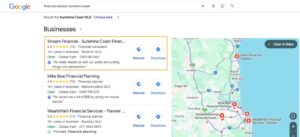
As featured above, Stream Financial is one of our long-term clients. Their strong Google Reviews and location-specified company name, along with numerous other elements we do behind the scenes, like weekly blog posts, help their advice practice stand out in search results.
7. Create localised content for better SEO
Publishing location-specific blog content helps establish authority and attract local clients.
Content ideas
- Write blog posts on local financial trends, tax strategies, or case studies.
- Feature client success stories related to your local market.
- Host webinars or collaborate with local business groups.
Keyword placement and content structure
- Use H1 and H2 headings with location-specific keywords.
- Ensure meta descriptions include local keywords, niches and service areas.
- Link blog posts to service pages and location landing pages for stronger SEO.
Using categories and tags strategically
- Group blogs under relevant categories (e.g., Retirement Planning).
- Use specific tags for each location and topic (e.g., financial planning Northern Beaches Sydney).
- Make category pages indexable so Google can rank them independently.
While many local SEO strategies can be managed in-house, certain technical aspects require specialised expertise. An SEO specialist can help fine-tune your strategy, but a professional developer is essential for more advanced optimisation, including structured data, website speed enhancements, and resolving technical SEO errors.
8. Make your website faster to boost SEO and user experience
It’s important that your advice practice uses a professional service that manages these technical aspects for you. A fast website ranks higher in search results and provides a better user experience.
How to speed up your website
- Choose a fast, reliable hosting provider.
- Optimise images using plugins like ShortPixel.
- Enable lazy loading for images and videos.
- Implement caching solutions like Autoptimize, Varnish Cache, or Cloudflare for better load times.
Website speed is critical for SEO, user experience, and reliability. Caching significantly improves performance by storing frequently accessed pages and data, reducing server load and delivering content faster.
9. Use schema markup to help Google and your SEO
Schema markup helps Google understand key business details and improve search visibility.
Best Google and SEO practices
- Google uses structured data to display rich search results. For financial advisers, schema markup can also:
- Highlight licensing details (e.g., AFSL number).
- Add review schema for testimonials (ensure compliance with ASIC regulations).
- Improve rankings for FAQs related to retirement planning or investment strategies.
- Add FAQ schema to answer common client queries in search results.
10. Fix technical SEO issues and submit your website to Google
To ensure your website is indexed and ranking well, follow these steps.
SEO checklist
- Install an SSL certificate (Google prioritises HTTPS websites). You can learn more about this in our blog on technical website terminology here.
- Submit an XML sitemap via Google Search Console.
- Use Google Search Console or an SEO audit tool to check your site regularly for broken links, redirect chains, and crawl errors. Addressing these issues ensures that search engines can index your site correctly and that users don’t encounter dead links.
- Monitor website traffic and adjust content based on performance data. Read part one of our blog here to learn more about website analytics.
Just as your clients turn to you for expert financial advice, your website deserves the same level of specialised care. While many aspects of local SEO can be managed in-house, some technical elements require professional support. A well-optimised website ensures that your digital presence is as polished and trustworthy as the advice you provide.
Over and out
A well-optimised website helps your advice business appear where it matters, right in front of prospective clients.
Need help refining your local SEO strategy? Book a chat to explore how we can boost your rankings, attract the right leads, and strengthen your online reputation today.
Local SEO FAQs
An SSL certificate is a small data file that activates the padlock icon and “HTTPS” in your website’s address bar. It encrypts the connection between your website and the visitor’s browser, meaning that any information submitted through your site, such as a contact form or triage questionnaire, cannot be intercepted in transit. Google has used HTTPS as a ranking signal since 2014, meaning websites without a valid SSL certificate rank lower in search results than those with one.
Beyond SEO, most modern browsers display a “Not secure” warning to visitors on HTTP sites, which is a significant trust issue for a financial advice firm. SSL certificates need to be renewed periodically, typically annually, and an expired certificate triggers the same browser warnings as no certificate at all. Your web hosting provider manages this, and most reputable hosts offer auto-renewal. If you are unsure whether your certificate is current and set to renew automatically, log in to your hosting dashboard or contact your web developer to confirm the certificate status and renewal settings.
Schema markup is a block of code added to your website’s pages that provides search engines with structured information about your business in a format they can read and use directly. Rather than Google having to interpret your page to work out what you do and where you are located, schema tells it explicitly. For a financial advice firm, this might include your business name, address, phone number, opening hours, AFSL number, and the types of services you offer.
When the schema is set up correctly, Google can display this information in search results as rich snippets, which are enhanced listings that show additional details below your page title. A practical example is the FAQ schema: if you add it to a page that answers common client questions, Google may display those questions and answers directly in search results, giving your listing more visibility without the client needing to click through. The article recommends the Schema and Structured Data plugin for WordPress, which handles this without requiring you to write code manually.
Google Search Console is a free tool from Google that shows how your website performs in search results and flags any technical issues that may be affecting your visibility. It is separate from Google Analytics, which tracks visitor behaviour on your site. Search Console focuses on how Google sees and indexes your site. For an advice firm, the most useful things to monitor are the pages Google has indexed (and any that it has not), any crawl errors or broken links flagged under the Coverage report, your average search rankings for key terms under the Performance report, and any manual actions or security issues that Google has identified.
You should also use it to submit your XML sitemap, which is a file that lists all the pages on your site and helps Google discover and index them efficiently. If you have not yet connected your website to Google Search Console, your web developer can set this up in under 30 minutes, and access can be shared so multiple people can view the data.
A local citation is any online mention of your business name, address, and phone number, typically in a directory, listing site, or industry database. Citations help Google verify that your business is legitimate and located where you say it is, which improves your visibility in local search results. The consistency of your details across citations matters more than most advisers realise. If your business is listed as “Smith Financial Planning” on your website, “Smith Financial” on Yellow Pages, and “Smith Financial Planning Pty Ltd” on the FAAA directory,
Google treats these as potentially distinct entities rather than confirming they are the same business. Similarly, minor differences in address format, such as “Level 2” versus “L2,” or phone number format, can dilute the signal. Before building new citations, audit your existing ones by searching your business name and checking how it appears across the major directories the article mentions. Correct any inconsistencies so that your name, address, and phone number are formatted identically everywhere they appear.
Caching is the process of storing a saved version of your website’s pages so that when a visitor loads your site, their browser or your server can serve that saved version rather than rebuilding the page from scratch each time. On a WordPress website, a page that isn’t cached has to query your database, run code, and assemble the page every time someone visits it, which takes time. With caching enabled, the first visitor triggers the page to be built and saved, and every subsequent visitor receives that saved version almost instantly.
This directly improves your page load speed, which Google uses as a ranking factor for both desktop and mobile search results. Slow websites also have higher bounce rates, meaning visitors leave before engaging, which sends a negative signal to Google over time. The article mentions tools including Autoptimize, Varnish Cache, and Cloudflare. Of these, Cloudflare is the most widely used and offers a free tier that provides caching, security, and basic performance improvements with minimal configuration.

The Trust Stack
Subcribe for exclusive adviser insights to build credibility at scale.